A complete, containerized payment processing simulation platform — 11 integrated services spanning card simulation, terminal emulation, ISO 8583 switching, cryptographic HSM, RF analysis, and 4 dedicated web management interfaces.
Explore the PlatformFour-layer containerized architecture simulating the complete payment chain from physical card to issuer authorization — deployed as containers on Linux or edge nodes.
11 integrated services simulate the complete payment chain — from card to issuer — enabling banks and researchers to safely test real-world attack scenarios.
Virtual EMV cards, physical chip-card reader integration, and fully functional POS/ATM terminal emulators for end-to-end transaction testing.
Full ISO 8583 message routing engine connecting simulated terminals with issuer and acquirer backends with BIN-based routing and MAC integrity checks.
Full bank simulation with dedicated web UIs for managing virtual cards, merchants, cryptographic EMV keys, and terminal deployments in a closed-loop environment.
Software Hardware Security Module for all cryptographic operations — key generation, ARQC validation, PIN block encryption, and MAC generation without physical hardware dependency.
Direct RF-hardware integration for contactless relay attack testing, RF sniffing, pre-play attack simulation and timing-based vulnerability discovery.
Centralized log analytics for deep ISO 8583 message tracing, transaction timeline analysis, and automated anomaly alerting across all services.
Three services we are building to extend the ecosystem into automated terminal profiling, compliance baselining, and reporting — covering the full POS/ATM testing scope.
Automated fingerprinting of a connected POS/ATM terminal — scanning known AIDs, extracting capabilities, and running contactless RF and timing analysis.
Compares a terminal's configuration against compliance baselines (EMVCo, PCI PTS v6) and flags configuration drift with a security score.
Turns profiling and comparison results into executive, technical, and compliance reports — with scheduled monthly assessments.
Our analysis tooling parses real transaction data and surfaces the indicators of relay, pre-play, and tampering attacks across the EMV and ISO message layers.
Parses EMV TLV (DE55) into a readable tree, decodes the TVR (tag 95) bit by bit, and explains every cryptogram and verification field.
Batch analysis over transaction logs that flags ATC non-monotonicity, duplicated or low-entropy Unpredictable Numbers, and cross-field inconsistencies.
Correlates transactions across terminals and time to expose relay timing signatures and pre-computed ARQC (pre-play) patterns.
APDU-level ISO 7816 analysis mapped against a normalized EMV / ISO attack matrix, turning raw captures into prioritized findings.
Four browser-based management consoles provide complete control over the simulated payment ecosystem — no terminal knowledge required.
Centralized monitoring interface — real-time health status of all 11 services, transaction visualization, Pi node connectivity, and deployment management.
localhost:3000Manage virtual card-issuing banks, control EMV cryptographic keys, provision test cards, and monitor authorization decisions in a closed-loop scenario.
localhost:8084Register test merchants, deploy and configure virtual POS/ATM terminals, and monitor incoming authorization requests and settlement flows.
localhost:8085Deep-trace ISO 8583 messages and transaction logs through an integrated log-analytics stack with pre-built dashboards for anomaly and vulnerability detection.
localhost:5601Visualizing virtual transactions, cards, and simulated payment networks in real-time.
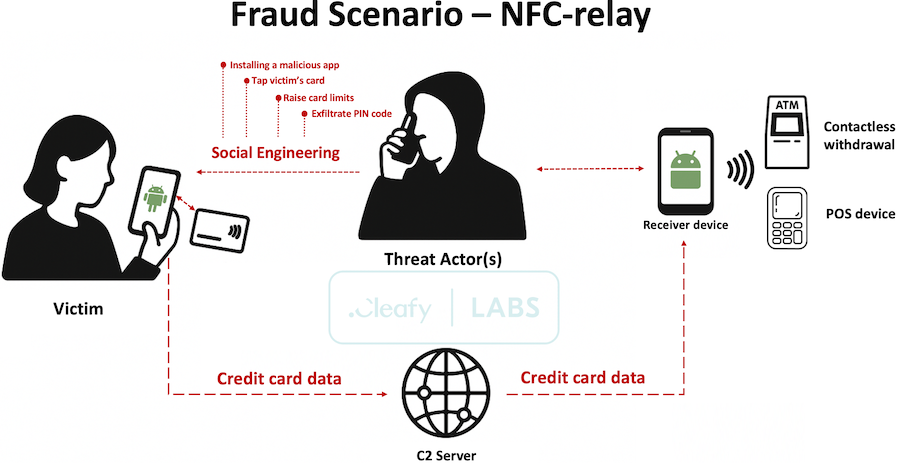
The platform actively simulates and tests 39+ edge-case attack scenarios spanning EMV, ISO 7816, ISO 8583, and cross-layer vulnerabilities.
| Attack / Technique | Target Layer | Severity | Vulnerability Description | Detection Indicator |
|---|---|---|---|---|
| Relay Attacks | EMV / NFC | Medium | Tunneling the EMV dialogue via Android OTS devices, bypassing distance bounding without cryptogram modification. | Atypical TVR/CVR timestamps, NoCVM near limits, response time >500ms. |
| Pre-play Attacks | EMV / POS | Medium | Exploiting predictable Terminal Unpredictable Number (UN/9F37) allowing pre-computation of ARQCs for future use. | Duplicated or jumping ATC (9F36), repeated UN pattern analysis. |
| ISO 8583 MITM | Acquirer / Switch | High | Missing MAC/Sign (DE64/DE128) between participants allowing modification of amount (F4) or currency (F49) in transit. | Log mismatch between terminal and switch; invalid or missing MAC fields. |
| Fallback / Downgrade | POS / Host | Medium | Artificially failing chip read to force Magnetic Stripe (MSR) fallback or downgrading CDA to SDA/DDA. | Unusual fallback spikes per branch/terminal; Condition Code F22 mismatch. |
| Amount Injection | ISO 8583 / DE55 | High | Desync between EMV amount in ARQC (tag 9F02) and ISO 8583 Field 4 — Issuer approves a different amount than presented. | ARQC re-calculation mismatch; DE55 TLV vs F4/F49 discrepancy in logs. |
| Cryptogram Replay | EMV / Online | Medium | Resubmitting a previously captured valid ARQC (9F26) without ATC replay detection at the Issuer. | Duplicated ATC across different merchants/geo; ARQC already seen in Issuer database. |
| CVM Bypass | POS / Contactless | Medium | No CVM (Cardholder Verification Method) forced via misconfigured terminal limits or manipulated CVM list selection. | CVR (9F10) shows "PIN not verified"; repeated NoCVM transactions near limit threshold. |
| Terminal ID Spoofing | Acquirer | High | Cloning or substituting terminal TID (DE41) / MID (DE42) to bypass anti-fraud geographical and behavioral rules. | Same TID appearing from different merchant locations; geo-velocity anomalies. |
Test POS/ATM configurations against relay, pre-play, fallback, and cryptogram manipulation attacks before pushing to production — not after a breach.
Provide red teams and security researchers a safe, isolated sandbox to discover unknown vulnerabilities without touching live network infrastructure or customer data.
Validate EMV implementations against PCI DSS and EMV Level 1/2 standards through repeatable automated test cases with full centralized audit trails.
Contact us for a live demonstration of the POS/ATM Vulnerability Testing Ecosystem and see how it can fortify your defenses.